
Modest Gardens
Cusco, Peru

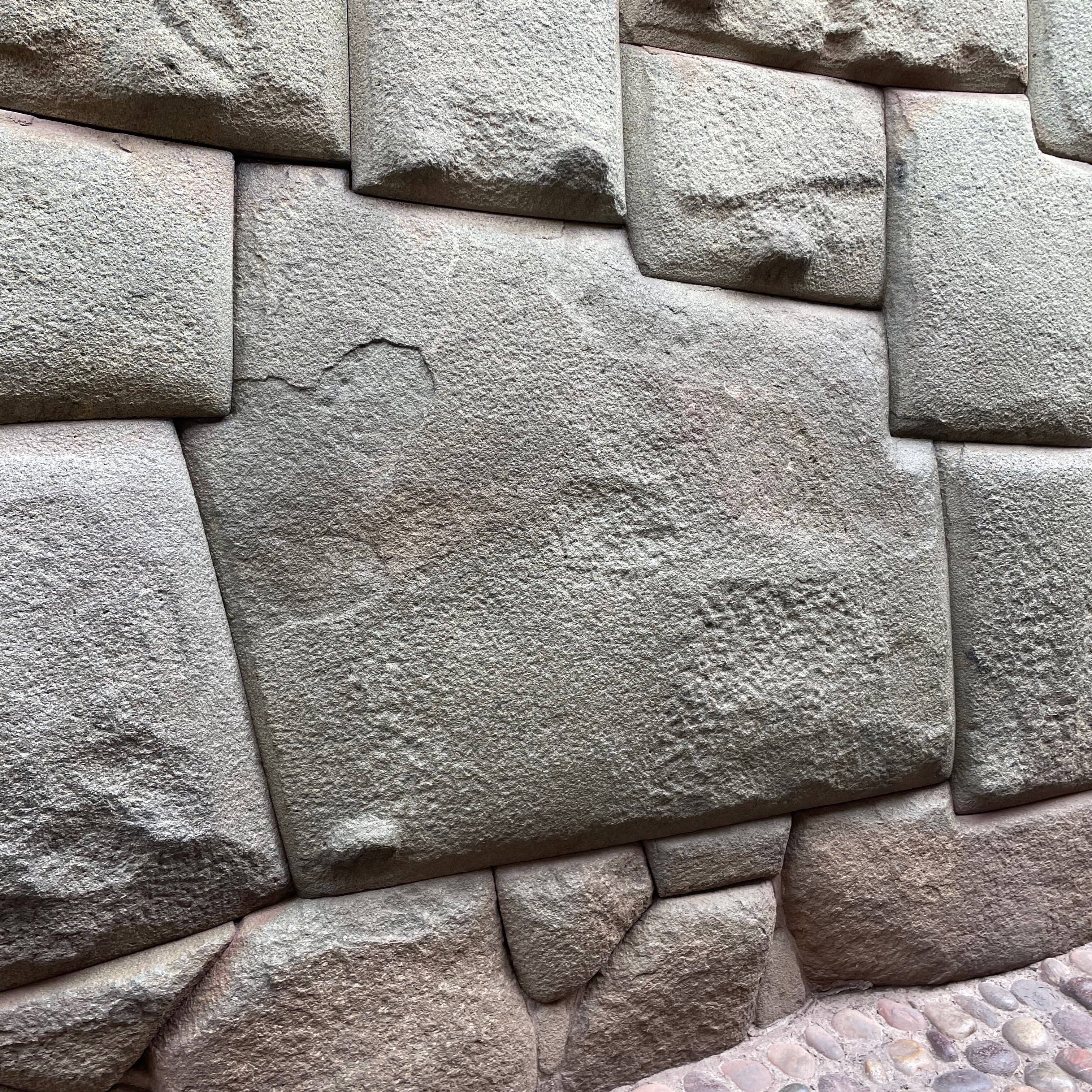
Stone with 12 vertices, Inca wall, Cusco.
How to garden at 11,000 feet? Gardening in the Andean city of Cusco, capital of the late Inca empire and now bustling Peruvian tourist mecca and regional metropolis, has some challenges. The altitude, 11,100 feet and more—though truly lung-busting for new human arrivals—isn’t one of them.
Cusco is a paradox. The city sits at 13.5 degrees South latitude—roughly the same as Lilongwe, Malawi, Salvador, Brazil, or American Samoa—squarely in the tropics. But its altitude literally leaves the tropical below. The city and its valley are surrounded by perennially icy peaks towering 18- and 20,000 feet into the sky—true Alpine zones—but at just 13.5 degrees from the Equator, 11,000 feet is an odd kind of sweet spot. Daytime temperatures are closer to those of a mild temperate zone: highs in the low to upper 60s (Fahrenheit), year-round. Nights are chilly—in the 40s in the wetter summer (November-April in the Southern Hemisphere) to freezing or below in the dry winter (June-October). True tropicals excluded, just about anything will grow there. And it is bright: the sun is piercing in the thin air, and clouds are rare.
A bigger problem is finding ground to grow in. Cusco is a stone city: the Incas and the ancient cultures that came before them were master-masons, building walls, battlements, staircases, roads and pavements with massive, intricately-carved and -fitted stones, many brought long distances to the Cusco valley. Their engineering was mind-bogglingly complex: at times they used square stones, fit in straight lines, as do other cultures; at others, they custom-cut and -fit irregular shapes together—a wall in the old city center has hundreds of pieces with seven or more points or vertices, each stone unique, perfectly locked with its neighbors such that a sheet of paper can’t be inserted into the joints. One stone has 12-points—a wonder of the world, just another rock in a wall lining an old alley. The stones were somehow fitted together under pressure, such that the conquering Spanish, after pulling the Indian structures apart, couldn’t properly rebuild them because they lacked the knowledge of pressure fitting. To this day, we don’t fully understand how they did it.
Agriculture was carried on outside the city, on terraced hillsides—themselves built with the same impressive technique and effort. Little gardening apparently occurred in town. The Spanish, from the 16th century, built their buildings with interior courtyards, according to Mediterranean practice, often planted with trees and ornamental plants and brightened with fountains. Today, interior gardens are common, but a tourist can rarely see them, except peeking through a doorway of a private house or visiting one of the luxury hotels that have taken over old monasteries and court buildings in the historic center. These inside private gardens are hidden, and so, from the experience of a person walking Cusco’s streets, they may as well not exist.
What a walker will see are the few public squares, originally laid out by the Spanish imperial administration to control space according to the rules of their colonizing handbook, the Law of the Indies: squares or rectangles, with church, administrative, and business buildings facing one another on three sides, and opulent private residences occupying the rest. The Plaza de Armas is the biggest, at the center of the center of the old city, done up since the late 19th century in the textbook Victorian way with a pompous central fountain (complete with sculptures that distort and whitewash Spain’s imperial history), crossing paths, benches, swaths of lawn, and bedding schemes with carefully-tended annuals in bright, hot colors. When I was there, earlier this year, the plaza had daily rehearsals and events with parades featuring squads in formation and marching bands, all wearing military-style uniforms and brimmed caps smacking of Franco-era Spain—a hangover of Peru’s and Latin America’s general history of authoritarianism, showing its stuff, still, in front of the Catholic cathedral, which was erected on the ruins of the Inca palaces, using their stones. Fitting indeed.


Regular, shall we say, people’s gardens that are visible to the public are a different thing altogether: scraps and slices of dirt, spaces-in-between, often triangles, frequently three-dimensional with oddly-angled walls, at the intersections of streets, and strips at the base of walls. These are planted, unpretentiously, mostly with the plants in mind—flowering, variegated, triumphantly growing in the midst of the traffic, noise, and pollution of modern Cusco. But mostly, Cusqueños, as the locals are called, garden in containers. Especially in the “nicer” neighborhoods—and Cusco is a tourist-dependent city, so efforts are made to spruce things up—there are pots, usually terra cotta, on the street and sidewalk edges, on walls, hung with iron hoops and hooks in the classic Mediterranean way. On some touristy streets you can feel like you’re in Seville or Ibiza or Marseilles or Mykonos, with skeins of red pots filled with geraniums festooning the walls of every alley. Sometimes, creativity not to say frugality replaces the pots with other vessels. On a long wall in the newly- trendy neighborhood of San Blas was a line of diverse teapots redeployed as flowerpots. But mostly, the containers are plastic buckets, five- or fifteen-gallon, like what we in the US would get at Home Depot for random jobs. Here, they are often improved upon, painted blue, red, white, or another color, and planted with what grows well.


This was a lovely return to a place I didn't get to spend anywhere near enough time.